















































RentAHomeInAruba.com · Practical guides
Choose an Aruba rental area around your daily journeys
Published 5 November 2026

A rental home’s area affects more than the view from its windows. Think about the journeys you expect to make most often: groceries, beach access, meals, visiting friends and travel to and from the airport. A short list of everyday destinations gives an area comparison a practical purpose without relying on vague descriptions such as central or close to everything.
Use regional information as orientation
The Aruba Tourism Authority region guide introduces the island’s different areas. Read it to establish names and broad orientation, then investigate the particular home. A region is not a property-level guarantee of quiet, beach access, walkability or convenient transport.
For example, the official Savaneta overview places it on Aruba’s southwestern coast. That is useful geographical context, not evidence that a rental advertised under that area name has a waterfront position. Ask the provider to distinguish an area description from the home’s actual permitted public location.
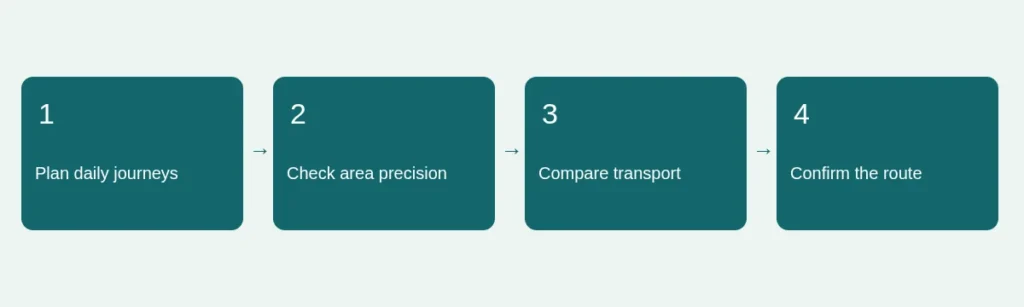
Compare the journeys you will repeat
Choose three or four important destinations and note how you plan to reach them. If you expect to walk, ask about the actual route, crossings, surfaces and lighting. If you plan to drive, ask where the car can be parked and whether access instructions identify the correct entrance. Avoid treating a straight-line map distance as a walking or driving time.
Any quoted travel time should have a route, mode and context. Traffic, stops and departure time can change a journey. Keep a margin around time-sensitive travel rather than turning a provider’s estimate into a guaranteed schedule. Request updated instructions if your plans change.
Respect the home’s address permissions
Not every provider has permission to publish a precise street address. A directory can use an approved area description while leaving private access details for direct communication with the responsible provider. Record the location precision explicitly so that an approximate pin is not mistaken for the front door.
Before relying on an area-only listing, ask when the exact arrival address will be supplied and how you can check that it corresponds to the same property identifier. Do not request private resident information for a public directory entry, and do not place access codes or key locations in a listing description.
Test your preferred routine
Consider a day when different group members want different activities. Will everyone depend on one vehicle? Is a late arrival workable? Can groceries be obtained before check-in, or does the provider have another practical suggestion? These questions often reveal transport constraints more clearly than an area’s promotional reputation.
Noise and surroundings are also property-specific. Ask about current nearby works, shared entrances or recurring activity that could affect your intended routine. A provider may not be able to predict everything, so keep the difference between a dated answer and a future guarantee visible in your notes.
Keep location and suitability separate
An attractive area may still contain a home that does not suit your group’s sleeping arrangements or access requirements. Compare location alongside capacity and room layout, not instead of them. The best shortlist is one in which each essential need has an answer and each uncertainty has a clear follow-up question.
Use our Areas page for research prompts and native area navigation. Initially there are no imported property records. Area names and editorial guidance do not indicate current availability, and we do not offer live journey tracking or a booking service.
Editorial guidance reviewed 5 November 2026. Linked primary sources inform general context; property-specific facts require direct verification.