















































RentAHomeInAruba.com · Practical guides
Check the home, the provider and the source separately
Published 5 November 2026

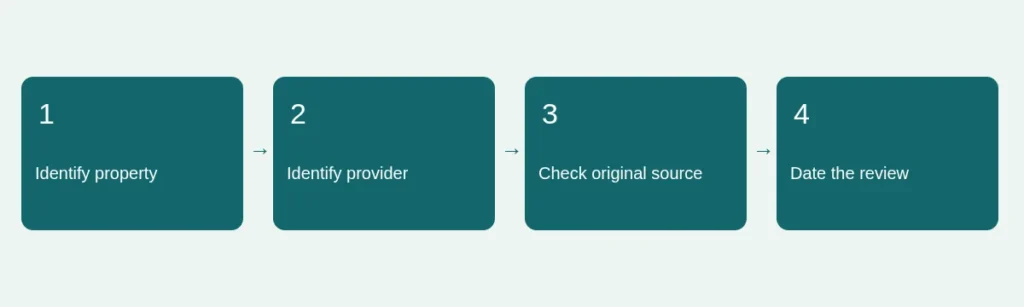
One home can appear under more than one name, and one provider can manage many homes. A useful comparison therefore checks the property and the responsible provider separately. A familiar-looking photograph or a matching area name is not enough to establish that two descriptions refer to the same place.
Identify the exact property
Ask for the source-issued property reference and the current name used by the responsible provider. Keep that identifier with the home’s type, approved location precision, capacity and dated source link. If an advertisement sends you to a page with a different identifier, resolve the difference directly before relying on its facts.
A private street address should not be published merely to make a directory entry look complete. Record the owner’s permitted public location detail. Specific arrival instructions, access codes and private resident information belong in appropriate direct communication, not a public listing description.
Identify who is responsible
Find out which provider or manager will answer questions about the home and which website or contact channel they authorize for public use. A provider reference helps distinguish a property manager from another organization with a similar name. A contact enquiry does not establish ownership, and directory account registration must not transfer a listing to an unverified claimant.
The Aruba Tourism Authority rental overview can provide an official starting point for accommodation research. Inclusion on a general information page does not independently verify a particular offer, future availability or a person contacting you through another channel.
Separate three different dates
Record the date on which the provider says the information was updated. Separately record when an editor checked the original source. A website publication date is a third item and may refer to the article or page rather than the home’s condition. Do not fill a missing provider-update date with today’s date.
When evidence changes, preserve the stable identifier and document what changed. For a significant discrepancy, seek clarification instead of silently choosing one source. Two pages repeating the same text are not necessarily two independent confirmations, particularly when both derive from one original description.
Check permission for photographs and wording
A public image is not automatically licensed for copying into a directory. Record who owns it, where it came from and the uses permitted. A legitimate provider link can be stored without importing the provider’s entire photo library or reproducing its description. Ask for clear permission before publishing material that belongs to someone else.
Use accurate images of the exact property for a real listing. Generated editorial scenes should be labelled illustrations and kept separate from listing evidence. Do not convert the Wacamaya promotional cards in the sidebar into a property dataset: they have a different purpose and an independent source.
Keep a compact evidence record
For each proposed entry, keep the property identifier, provider identifier, permitted location detail, field source, provider-update date, editorial-check date and photo-rights record. Mark anything unresolved. This makes a later correction more reliable than relying on memory or the most recent promotional card.
Use our property-information standard and research guide to organize these questions. This initial build contains no imported property listings, fabricated ratings or verification badges. Future records require separately approved sources and moderation. A directory entry will remain information for research, not proof of a reservation, payment protection or a booking guarantee.
Editorial guidance reviewed 5 November 2026. Linked primary sources inform general context; property-specific facts require direct verification.