















































RentAHomeInAruba.com · Practical guides
Bedrooms, beds and guests: read capacity without guessing
Published 5 November 2026

A headline guest count cannot tell you exactly how your group will sleep. Bedrooms, beds and maximum permitted guests describe different things. A useful rental-home comparison records all three and checks whether the arrangement works for the people travelling. Do that before treating a larger number as a better choice.
Count people before rooms
Write down every person who will stay, including children, and ask the provider how their occupancy rules apply. Do not decide that a young child is excluded from a limit or that an extra visitor can stay overnight without agreement. Obtain the maximum permitted occupancy for the exact home in writing.
Then list the sleeping arrangement each person needs. Separate bedrooms may matter for privacy, different schedules or a child who needs a particular routine. A home described as sleeping several people may include a sofa bed or a shared room; neither is necessarily unsuitable, but neither should be discovered only on arrival.
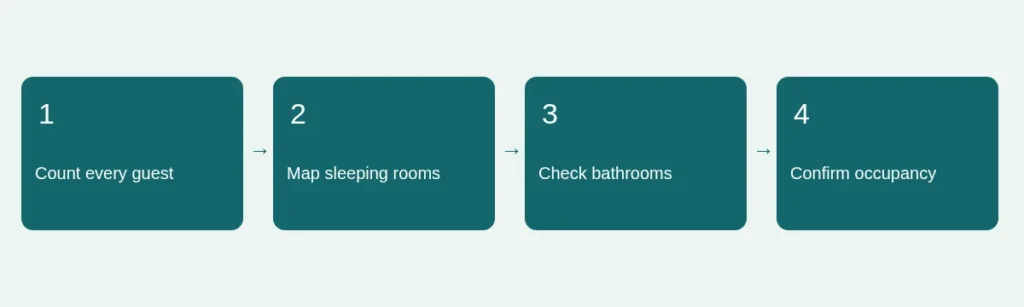
Ask for a room-by-room description
Request the number of separate bedrooms, the beds in each and any sleeping space outside a bedroom. Ask whether a room has its own door and how it connects to other spaces. If photographs and the written description seem inconsistent, ask which one reflects the current arrangement rather than guessing from the most attractive image.
For someone who needs a particular bed size or clear route around furniture, request the measurement directly. Do not infer dimensions from a wide-angle photograph. Ask whether any temporary bed changes the usable floor space or affects access to doors, storage or the bathroom.
Read bathrooms as practical facilities
A bathroom total may not explain which facilities are shared or which room has access. Ask how many toilets, showers and baths are included, whether any are en suite, and whether everyone can reach a bathroom without crossing another sleeping room. Clarify any partial-bathroom description before comparing two homes.
If a particular bathing arrangement is essential, describe the need rather than asking whether a bathroom is generally accessible. Details such as a step into a shower, a fixed screen or available turning space need specific evidence. Unknown information should remain unknown until the provider supplies a clear answer.
Check living capacity too
Sleeping capacity is only part of household comfort. Consider whether the dining table, indoor seating, kitchen storage and outside seating suit the group. If everyone expects to eat together or work remotely at the same time, identify that requirement explicitly. Do not assume that a guest limit certifies the number of useful workspaces.
Shared facilities require additional questions. Ask whether laundry, parking or a community pool is shared, whether any rules affect guests, and what happens if a facility is unavailable. These are provider-specific arrangements, not benefits established by the home’s type or general area.
Record dated evidence rather than assurances
The official Aruba vacation-rental overview describes a broad range of accommodation. It does not establish the occupancy or bed configuration of an individual home. Keep the original provider source, exact home identifier, answer date and any limitations with your comparison.
Use the directory’s bedrooms, bathrooms and guests fields as separately documented facts. Our initial search uses exact counts, not an unverified minimum-capacity calculation. Read the amenity evidence guide for the next checks, and start from the rental-home directory when approved property information is added. No count implies live availability or a confirmed reservation.
Editorial guidance reviewed 5 November 2026. Linked primary sources inform general context; property-specific facts require direct verification.